







 The concept of spinal abnormalities producing illness is an old idea.
The early osteopathic physicians spoke of "lesions" (now called "somatic
dysfunction). The early chiropractors called these abnormalities
"subluxations" (now called a "subluxation complex"). Edgar Cayce used both
designations (lesions and subluxations) while also simply referring to
"pressures" and "impingements" at specific vertebral segments. Like
the early osteopaths, Cayce also recognized that the abnormalities are
not restricted to the skeletal structure ("bony lesions") but also could
manifest as "muscular lesions," "ligamentous lesions," "circular lesions,"
"floating lesions," and "reflex lesions."
The concept of spinal abnormalities producing illness is an old idea.
The early osteopathic physicians spoke of "lesions" (now called "somatic
dysfunction). The early chiropractors called these abnormalities
"subluxations" (now called a "subluxation complex"). Edgar Cayce used both
designations (lesions and subluxations) while also simply referring to
"pressures" and "impingements" at specific vertebral segments. Like
the early osteopaths, Cayce also recognized that the abnormalities are
not restricted to the skeletal structure ("bony lesions") but also could
manifest as "muscular lesions," "ligamentous lesions," "circular lesions,"
"floating lesions," and "reflex lesions."
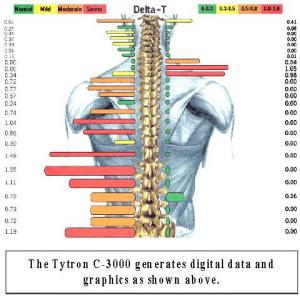
According to these historic sources, the various forms of spinal lesions and subluxations can cause illness and reduced quality of life. Hence, manual treatment (spinal adjustment or manipulation) is an appropriate treatment for improving health. According to the early osteopaths and Edgar Cayce, one common characteristic of the various forms of spinal abnormality is temperature variation. Thus, the early osteopaths typically used their hands to detect changes in temperatures along the spine (paraspinal) when doing an examination. The early chiropractors were also aware of thermal variations associated with spinal subluxations. Although they also relied on manual palpation of the spine to detect thermal variations, some enterprising chiropractors developed an instrument called a neurocalometer that could perform this type of assessment. Edgar Cayce endorsed this instrument in at least two of his readings, stating: ". but there has been perfected or used in the chiropractic association a thermometer, or a gadget that run along the spine shows WHEN they [the centers] coordinate one with another, see?" (480-44) Cayce acknowledged that the device could be useful for detecting pathology and tracking the effects of treatment. In conjunction with the HRRC (Health and Rejuvenation Research Center - a division of the A.R.E.), Meridian Institute has conducted a preliminary research study using a modern equivalent of the neurocalometer. Meridian Institute research director Douglas Richards, Ph.D. will present the findings of the study at the annual convocation of the American Academy of Osteopathy in Norfolk, Virginia in March. The talk is titled, "Correlations Between Paraspinal Temperature Variation And Health Status: From Manual Therapeutic Art To Objective Measurement." The purpose of our study was to explore correlations
between paraspinal temperature variations and health quality of life. The
study compared paraspinal temperature measurements using the Tytron C-3000
with questionnaire measurements using the SF-36, a well-validated measure
of health status. Data from 79 people participating in health assessments
were used.
The findings support the ideas expressed by the early osteopaths, chiropractors, and the Cayce readings. Temperature variations along the spine that are believed to be associated with "lesions" and/or "subluxations" may be associated with health problems that can be objectively measured. This line of thinking is extremely controversial. In previous issues of this newsletter we have cited articles on this subject by Meridian Institute staff that have been published in medical journals. To review this literature, visit the Meridian Institute website at: http://www.meridianinstitute.com/publish.html Meridian Institute will continue researching the
connection between paraspinal thermography and health. We are currently
planning a follow-up study that will include additional measures (such
as heart rate variability and bioimpedance) for correlation with paraspinal
temperatures. Future studies will also examine the potential therapeutic
effects of manual therapy as measured by paraspinal thermography - just
as Edgar Cayce recommended.
TEMPLETON FOUNDATION AWARD Dr. Douglas Richards, Meridian Institute research director, recently received an award in the John Templeton Foundation's Creative Research in Neurobiology competition, for his essay, "Neurological Correlates of Transformational Experiences." The Templeton Foundation supports research and scholarship in the dialogue between religion and modern science and medicine. This competition was intended to produce new ideas for exploring the higher faculties of humanity (e.g., creativity, mystical experiences) using the techniques of neurobiology. A variety of experiences - visions, near-death experiences, mystical and numinous experiences - may lead to transformation of the personality, resulting in greater compassion, altruism, and universal love. Cognitive science has explored the reasoning capacities of the human mind/brain, but has heretofore paid little attention to these higher functions. There has been previous work on the role of the temporal lobe of the brain in such experiences (e.g., that of Michael Persinger), as well as some neuroimaging on the areas of the brain involved in meditation (e.g., that of Andrew Newberg). My approach here is to extend this work in several ways to explore the neurological correlates of transformational experiences: (1) better quantitative assessment of experiences, going beyond descriptive phenomenology, (2) more diversity of experiences, comparing spontaneous experiences to induced experiences, and particularly exploring the factors involved in positive vs. negative experiences (3) focusing specifically on neuroimaging, with near-death experiences as a model, and (4) using the results of neuroimaging to design experiments to induce experiences for controlled study. This approach has the potential to show coherent mechanisms for these experiences (as opposed to pathology caused by biological deterioration), encouraging further exploration to gain an understanding of their role in human existence. Dr. Richard's award-winning paper can be viewed on
the Meridian Institute website at:
TOMATO-BASED FOODS CUT RISK OF PROSTATE CANCER A recent study published in the Journal of the National Cancer Institute reports that a diet rich in tomato-based foods can reduce the risk of prostate cancer. When researchers analyzed the diets and prostate cancer data of more than 47,000 men (40-75 years old), they found that eating at least two meals each week containing tomato products reduced prostate cancer rates by 24 to 36 percent. The study is consistent with previous prostate cancer research involving foods that contain lycopene, a powerful antioxidant found in tomato products. Antioxidants are substances thought to protect against cancer by reducing tissue-damaging free radicals that are produced during metabolism. The researchers note that foods containing cooked tomatoes appear to be particularly beneficial in protecting against prostate cancer. Tomato sauce was a favorite food of the research participants and also seemed to provide the most protection. Cooking may allow the body to absorb more lycopene by breaking down the cell walls of the tomato. Interestingly, Edgar Cayce was a big advocate of tomatoes, both raw and cooked. When asked about the effects of eating an abundance of tomatoes he responded, "Quite a dissertation might be given as to the effect of tomatoes upon the human system. Of all the vegetables, tomatoes carry most of the vitamins in a well-balanced assimilative manner for the activities in the system. Yet if these are not cared for properly, they may become very destructive to a physical organism; that is, if they ripen after being pulled, or if there is the contamination with other influences." In numerous instances, Cayce also advised eating canned tomatoes unless they were fresh and vine-ripened: "Beware of raw tomatoes, unless well-ripened on the vine - not those gathered green and then ripened. Preferably use these cooked or canned, rather than raw - unless well ripened when gathered - from the vine." When canned, he cautioned against using sodium benzoate as a preservative. Cayce didn't make any specific statements regarding tomatoes as protecting against prostate cancer, but seemed to regard tomatoes, properly harvested and prepared, as having general health benefits. Perhaps future research will uncover additional positive effects of eating tomatoes! Reference Edward Giovannucci, Eric B. Rimm, Yan Liu, Meir J. Stampfer, and Walter
C. Willett. A Prospective Study of Tomato Products, Lycopene, and
Prostate Cancer Risk. J Natl Cancer Inst 2002; 94: 391-398.
CAYCE DIET FOR HEARTBURN This anecdote was provided by a fifty-four year old woman on January 10, 2002. "For the past 25 years, I have had awful heartburn. Fifteen years ago I had a bleeding ulcer that originated at the juncture of my stomach and esophagas and had to recieve 2 units of blood. Since then I have used Tagamet and Tums like candy to prevent a recurrence. Nights were the worst! "Three days ago I began following the Alkaline diet guidelines set down by Cayce. For the past two days I have had NO heartburn at all and have not taken one tagamet or Tums. I am able to sleep all night, even lying on my stomach, without a problem." On March 13, 2002 we received a follow up report that read: "As long as I follow the guidelines, I have remained heart-burn free. A small package of potatoes chips will give me heartburn, or a candy bar....but even then it is not as pervasive as it had been before following the alkaline diet guidelines. And, I try not to stray from the guidelines 90% of the time." Although Edgar Cayce provided individualized treatment
plans with varied dietary recommendations, many of his readings indicate
that for most people an alkaline-reacting diet is beneficial. Numerous
readings suggested that such a diet should consist of about 80 percent
alkaline-reacting foods (most fruits and vegetables) and about 20 percent
acid-reacting foods (such as meat, grains, and sweets).
|
